

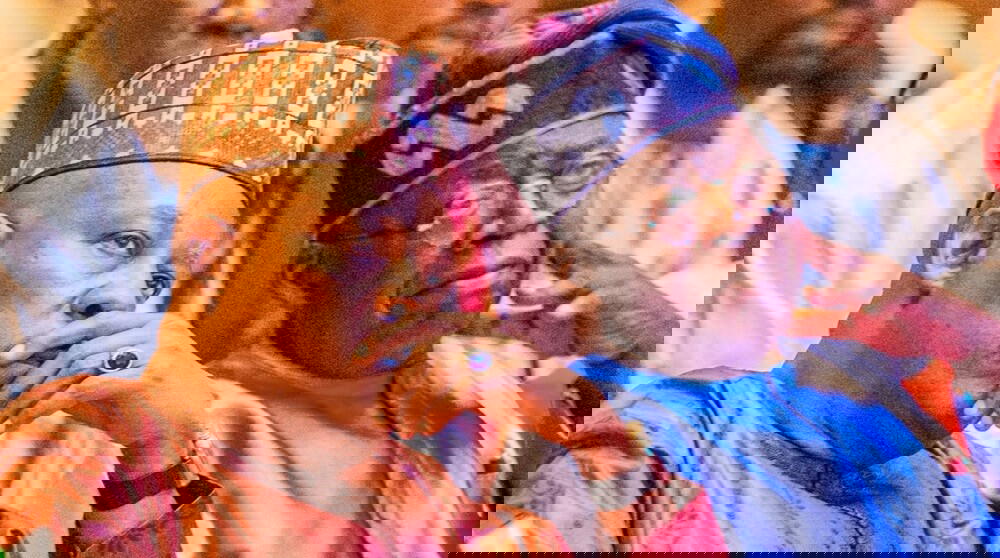
The banner was already hanging when Abdulkarim Lawan walked into the hall in Maiduguri. It stretched wide behind the podium at the North-East Zonal Public Hearing of the All Progressives Congress (APC), filled with familiar faces: President Bola Ahmed Tinubu, governors from the zone, and senior party officials.
But one face was missing. Lawan, Speaker of the Borno State House of Assembly and the longest-serving speaker in Nigeria’s history, noticed it instantly. The Vice President of the Federal Republic, Kashim Shettima; a son of Borno, former governor, and the most senior APC figure from the North-East, was nowhere on the banner.
When Lawan stood up to speak, it was not on the constitutional amendment agenda. His voice carried irritation and disbelief.
“Why would the Vice President’s picture not be included in the banner?” he asked. The hall answered with loud applause. What could have been dismissed as a design oversight now felt like a deliberate act, and a provocation.
Why This Absence Hit Harder
This was not the first time Shettima’s image had disappeared at a party event in the region. A similar exclusion at a gathering in Gombe State last year had sparked a fracas that disrupted proceedings entirely. But Maiduguri was different. It was home. And it came at a moment when Nigeria’s political class has begun quietly positioning for 2027.
Within the APC, a troubling speculation has gained ground: that President Tinubu may consider replacing Vice President Shettima on the party’s next presidential ticket, largely because of renewed debates around the Muslim–Muslim ticket and external pressure linked to religious balancing.
The omission of Shettima’s image gave physical form to what had until then existed mostly as whispers.
Inside the Party: Fear of a Costly Gamble
Abayomi Nurain Mumuni, an APC chieftain and security expert who served on the intelligence and security team of the Tinubu/Shettima Presidential Campaign Council in 2023, warned that replacing Shettima on religious grounds would be a dangerous political gamble.
According to Mumuni, the northern region currently lacks a Christian candidate with the political structure, grassroots acceptance and national reach needed to compensate for Shettima’s electoral value.
He argued that loyalty and consistency, qualities he said Shettima has demonstrated, are stabilising forces in governance.
Mumuni stressed that while calls for religious inclusivity are legitimate, altering a winning ticket could undermine internal cohesion, disrupt governance, and weaken the APC’s chances in 2027.
The North-East Pushes Back
For many in the North-East, the idea of dropping Shettima is viewed not as strategy but as betrayal. That sentiment was echoed by the APC Youth Parliament.
Speaking to journalists in Bauchi, its chairman, Kabiru Garba Kobi, dismissed rumours of Shettima’s replacement as divisive and dangerous, warning that such a move could cost President Tinubu massive support in the region.
Kobi insisted that Shettima remains the most unifying political figure in the North-East and a vital bridge between the region and the presidency. He cautioned against listening to voices he described as political opportunists who neither contributed to the APC’s victory in 2023 nor demonstrated loyalty to the party.
Foreign Pressure and Local Sensitivities
Behind the scenes, State House Aso Villa insiders acknowledge growing concern about foreign scrutiny, particularly from the United States, over Nigeria’s religious balance. Statements by U.S. President Donald Trump about Christian persecution in Nigeria have intensified debates within the ruling party.
Some party figures argue that Nigeria’s security leadership already reflects religious diversity, citing appointments across the armed forces, intelligence services and defence establishment. Others reject any suggestion that Nigeria’s electoral decisions should be influenced by foreign expectations.
The tension has further complicated internal discussions, blurring the line between domestic political calculation and external pressure.
North-Central Steps Back, Publicly
Amid speculation that the North-Central zone is pushing for a Christian vice-presidential candidate, the North-Central APC Forum issued a strong denial. The forum said it had no interest in the vice-presidential slot and was focused instead on contesting the presidency in 2031. The group warned that removing Shettima would be a grave political miscalculation that could shrink Tinubu’s vote base and hand the opposition a strategic advantage in 2027.
Public Reactions
“(It) is a potentially disruptive speculation, a kite being flown in political conversations, which could affect the fortunes of the ruling party, the All Progressives Congress (APC) and the relationship between President Bola Ahmed Tinubu and the Vice President, Senator Kashim Shettima, as Nigerians begin the dress rehearsal towards the 2027 general election,” said Reuben Abati, journalist and former presidential spokesperson.
“Any attempt to replace Senator Kashim Shettima would amount to a grave political miscalculation that could cost President Tinubu massive support in the north, especially the north-east,” said Kabiru Garba Kobi, President, APC Youth Parliament.
“Bola Tinubu is probably done with Shettima. He knows a Muslim-Muslim Ticket will not fly in 2027. He will need a Christian most likely from North Central to try to please that Region but, everything will fail in the end,” said Prof. Olusore Afuye, a political advocate.
“It has already been decided: Shettima will not be on the ticket for the 2027 presidential election. This isn’t really about the Muslim–Muslim ticket; it’s more about internal issues that occurred about a year ago,” said Engr. Arinze Cajet, political commentator.
The Silence at the Centre
Vice President Kashim Shettima has not responded publicly, not to the banner, not to the rumours, not to the speculation swirling around his political future.
But in Nigerian politics, silence is rarely empty. Sometimes it is a restraint. Sometimes it is a calculation. And sometimes, it is the calm before a reckoning.
What began as a missing photograph in Maiduguri has grown into a test of loyalty, power and political memory. As 2027 draws closer, the APC must decide whether altering a familiar equation will save it, or undo it.


0 Comments