

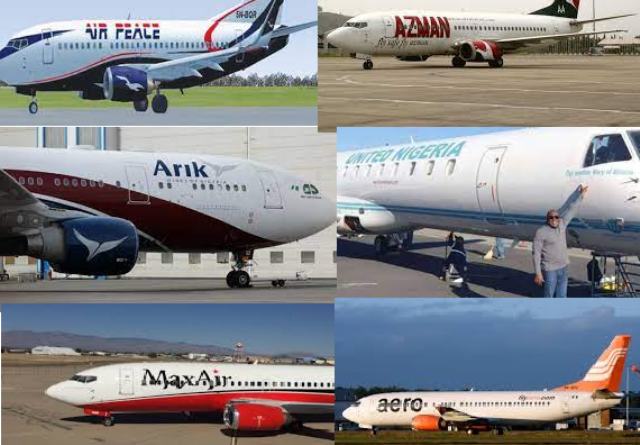
Domestic airlines in Nigeria are on the verge of shutting down operations nationwide over the rising cost of aviation fuel.
The planned action is expected to take effect from Thursday, April 30, 2026, if urgent intervention is not made.
Operators say the situation has become unbearable. They warn that continuing flights under the current conditions is no longer sustainable. The development has raised fears of major disruption for passengers across the country.
Findings show that several airlines have already engaged the Federal Government and fuel marketers. However, talks have not produced any concrete solution. This has left operators with limited options as the deadline draws closer.
The crisis is largely linked to the sharp increase in the price of Jet A1 fuel. Industry players say the cost has risen by more than 300 per cent since February. This spike has significantly pushed up operating expenses for airlines.
Passengers who depend on local flights for business and urgent travel now face uncertainty. Many are already making alternative arrangements as concerns grow over possible cancellations.
In an effort to address the situation, the Minister of Aviation and Aerospace Development, Festus Keyamo, held a meeting with airline operators and fuel marketers in Abuja. The meeting lasted two days but ended without an agreement.
After the discussions, the minister announced a 30 per cent reduction in aviation-related taxes. The move was aimed at easing the burden on operators. However, airline executives say the measure does not solve the main problem.
Speaking during the meeting, Allen Onyema, Vice President of the Airline Operators of Nigeria, acknowledged the government’s efforts. He, however, insisted that more must be done, especially regarding fuel pricing.
Onyema said, “This government has helped the industry more than anyone since 1999, and the President is even willing to waive 30 per cent of the debts airlines are owing.
“But the truth is that the marketers must be brought to book to explain how they came about the 300 per cent increase when even Dangote is surprised because what he is selling to us is still the cheapest.”
He later issued a strong warning at the end of the meeting. According to him, operators have given a seven-day ultimatum for action to be taken.
Onyema said, “Since the advent of the US-Iran war, there has been a spike in aviation fuel in Nigeria, which we, the Airline Operators of Nigeria, feel is not proportionate to the hike internationally.
“We expect that in the next 48 hours something drastic should be done because no airline will fly in this country in the next seven days if nothing is done, not because they don’t want to fly, but because fuel may not be available to us at sustainable pricing.”
He also gave details of the current fuel pricing. According to him, airlines used to buy fuel at about N900 per litre. That figure has now jumped to between N2,700 and N2,900. In some cases, it sells as high as N3,500.
“Before the crisis, we were buying fuel at about N900 per litre. Now it has risen to between N2,700 and N2,900, with some selling as high as N3,300 to N3,500,” he said.
He added that airlines are now operating mainly to settle fuel costs. “All the airlines in Nigeria have been flying to pay fuel marketers only, and you don’t want to compromise safety,” he stated.
Despite concerns about debts, airline officials say they are up to date with payments to key aviation agencies. These include the Federal Airports Authority of Nigeria and the Nigerian Airspace Management Agency.
Further checks reveal that the Airline Operators of Nigeria have written to the Federal Government requesting more relief measures. In the letter dated April 21 and signed by its President, Abdulmunaf Sarina, the group demanded urgent action.
Among the requests is the suspension of aviation taxes, fees, and charges for at least six months. The operators argue that this will help stabilise the sector.
They also proposed the introduction of a non-taxable fuel surcharge. According to them, this is a standard practice in global aviation. It would allow airlines to manage rising fuel costs without shutting down operations.
In addition, the group called on the government to direct fuel marketers to issue credit notes to affected airlines. They also suggested setting up a committee to review existing aviation charges and align them with international standards.
As the deadline approaches, uncertainty continues to grow within the aviation sector. Another airline executive, who spoke on condition of anonymity, said the threat remains real.
“If nothing is done, no airline will be flying by Thursday,” he warned.


0 Comments